
News Category
Contact Us
-
SHENZHEN HANDOPTICAL MANUFACTURE CO.,LTD
Address: No 104 Lijia Road ,Henggang, Longgang,Shenzhen,China(518115)
Mobile: 189 3867 9978
Wechat: 189 3867 9978
Q Q: 140 113 5799
Tel : +86-755-2862 4881
Fax: +86-755-2862 4880
E-mail: vip@handoptical.com
WhatsApp:+44 771 948 3678
Contact: John wong
With Bitverse's first AI glasses, NIMO, gaining significant industry attention for its outstanding performance, its optical solution provider, Nica Optics, has once again become a focal point in the sector. Based on current order volumes, AI glasses equipped with full holographic waveguide technology are expected to achieve substantial market growth.
As the world's first consumer-grade AI glasses equipped with a full holographic two-dimensional grating lightwaveguide, NIMO achieves a groundbreaking breakthrough: the device is exceptionally lightweight and slim, with an appearance indistinguishable from ordinary glasses. The lenses are transparent, the grating is nearly invisible, and issues like rainbow fringing and light leakage have been optimized to the point of being almost imperceptible.
The outstanding optical performance of NIMO stems from the "Starburst" waveguide lens developed by Nikka Optics. This lens weighs only 3.1±0.2g, with a thickness of 0.6±0.03mm, featuring over 95% light transmittance, a light leakage ratio of <1:140, and an efficacy of up to 1400nits/lm, elevating the optical experience of AI glasses to new heights.
In fact, this is not the first time Nica Optics has made waves. The 999-yuan Fengyi Smart AI Glasses, which sparked heated discussions last September, also featured an optical solution provided by Nica Optics.
While the industry remains constrained by technical bottlenecks such as weight, transparency, visible gratings, light leakage, and rainbow patterns, NIMO's dual breakthroughs in both appearance and performance have garnered significant industry attention. The answer lies in Nica Optics' in-depth R&D and mass production in the field of volumetric holographic waveguides. We engaged in an in-depth conversation with founder Du Youcheng, dissecting its technical secrets and pioneering explorations.
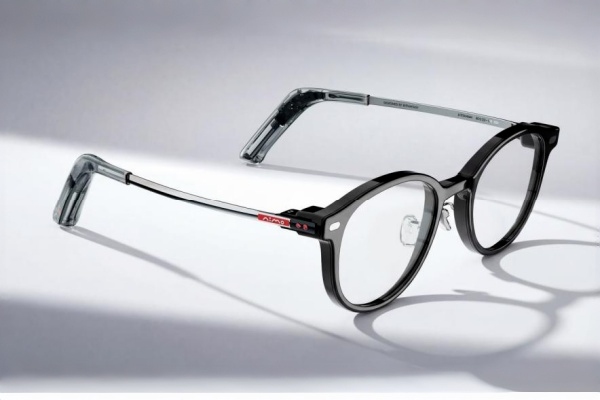
01 Slim Design: Systematic Optimization of Materials and Design
AR glasses are moving toward daily use, with lightweight design being the primary prerequisite. Niko Optical has kept the weight of waveguides around 3.1g, significantly lower than the industry average of 4-8g, achieved through comprehensive optimization of materials and optical design.
Du Youcheng explained that the company opted for thinner glass substrates with a primary refractive index of 1.6. Compared to the commonly available 1.8 refractive index materials on the market, these substrates offer lower density and reduced weight, while also demanding higher requirements for optical design.
For the most perceptible issues of rainbow effects and light leakage, Nika also adopts optical design as the core solution. Through sophisticated optical design, it achieves a 55-degree viewing angle free of rainbow effects, with clear design standards ensuring no rainbow effects within the central field of view and a 30-degree range on either side.
In terms of light leakage control, the team reduced the light leakage ratio to less than 1:140, achieving virtually no visible light leakage. This breakthrough primarily relies on the directional selectivity of the new Bragg grating technology, further lowering the leakage rate through optimized grating structure design. Du Youcheng also admitted that absolute zero light leakage is unattainable in optical principles, but the leakage has been controlled to near-perfect levels.
02 Grating Invisibility + Over 95% Light Transmittance: How to Achieve It?
To closely resemble ordinary glasses, besides being lightweight, it also requires a grating for invisibility and high lens transparency. The NIMO lens offers a visual experience nearly identical to conventional glasses, which benefits from the principles of volume holographic gratings and anti-reflective coatings, as well as breakthroughs in Nica's exposure process and core material parameters.
Du Youcheng stated that the transmittance of the Prague grating itself can reach 90%-92%. After applying anti-reflective coatings, the transmittance in non-grating areas reaches 98%, while the grating areas exceed 95%.
Meanwhile, the company employs a gradient grating exposure technique, dividing the grating into nearly 20 partitions to significantly enhance concealment. Additionally, to adapt to the 0.03CC optical engine, the team increased the light waveguide efficiency to 1400 nits/lm, with the core optimization focusing on the critical parameter of refractive index modulation in volume holographic materials.
03 Global First in Consumer-Level Mass Production of 2D Grating Volume Holography: Achieving a Technological Leap from Zero to One
The high performance of NIMO stems from Nica Optics' groundbreaking achievements in two-dimensional grating volume holography. As the world's first company to achieve mass production of consumer-grade two-dimensional grating volume holographic waveguides, Nica provides core support for AR glasses upgrades through process and material innovations.
Compared to traditional one-dimensional gratings, two-dimensional gratings integrate the coupling and turning gratings, eliminating the need for separate structures. This not only results in cleaner lenses and higher light transmittance but also offers greater flexibility in matching the grating layout to the position of the human eye.
The key to mass production lies in Nica's self-developed "Windmill Optical Path"—employing six-beam exposure technology to address the challenges of 2D grating processing while achieving breakthroughs in optical path stability and angular precision control.
The new process also drives material innovation. Industry-standard materials are only suitable for two-beam light exposure, while Nika has redeveloped a material system to meet the six-beam light requirements. The self-developed system, combining materials, supply chain, and exposure processing, ultimately enables mass production of two-dimensional grating holography.
04 2-week prototyping, 3-week mass production, rapid response to customer needs
Technological breakthroughs ultimately translate into mass production capabilities. With its production capacity and standardized services, Nikka Optics has become a core partner for AR device manufacturers, also ensuring the rapid deployment of NIMO.
Currently, Nikar orders are continuously increasing. The million-piece production line in Tianjin is set to commence operations this June, which will further reduce costs through large-scale mass production and accelerate the widespread adoption in the consumer segment.
In terms of service efficiency, Nikka achieves a 2-week sample delivery and 3-week production launch, leveraging Mask exposure technology to expedite customized development. Additionally, it offers comprehensive technical support throughout the entire process, including AA debugging, structural alignment, and full-machine production, with engineers stationed at the factory to assist in resolving tolerance and debugging challenges.
With this system, Nicka successfully served two clients, Xingyi and Bit Fantasy, within a year, demonstrating its scalable service capabilities.

From the mass production breakthrough of 2D grating holography to the lightweight, high-transparency, low-leakage, and rainbow-free wearing experience, and further to the million-level production capacity and efficient services, Nica Optics has laid a solid optical foundation for the consumer-oriented implementation of AR glasses.
With the production of the Tianjin production line and the cooperation with more manufacturers, Nika is promoting the use of volume holographic optical waveguides as the mainstream solution for AR, allowing AR glasses to truly enter the era of daily wear.
This article is compiled from the internet. If there is any infringement, please contact us for deletion.